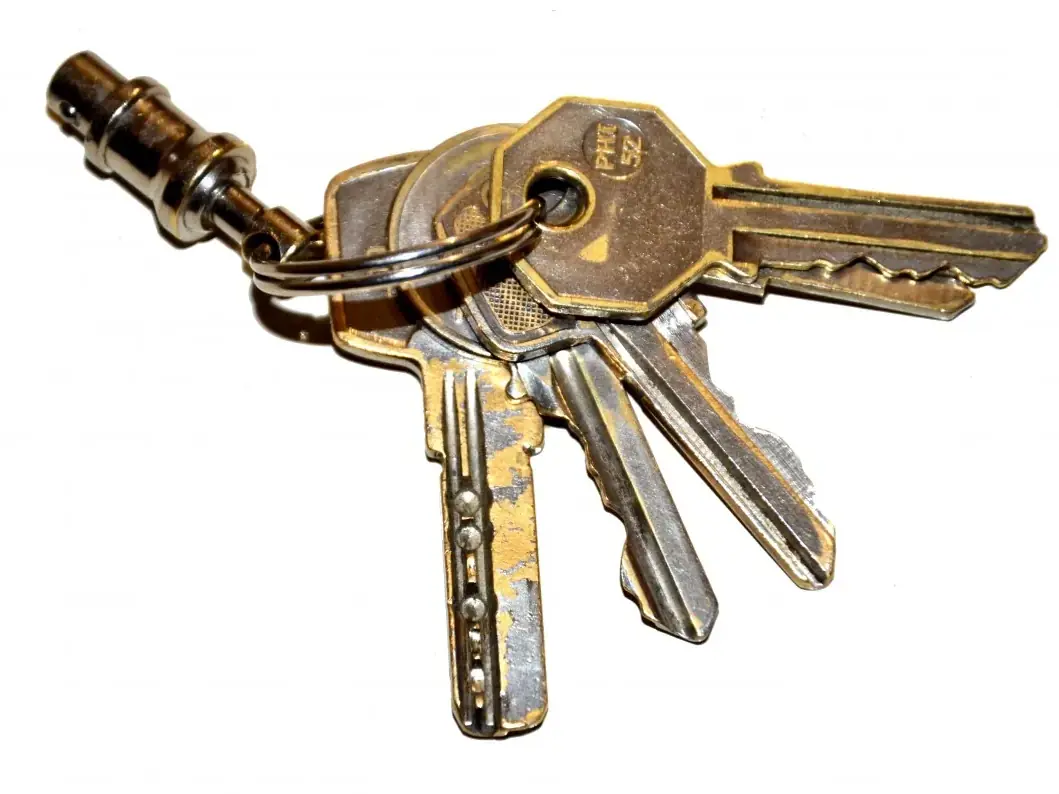
Two body lengths, two metals, one way of working. Below is what each body is made of, what it holds, how big and heavy it is closed, what fits on the posts and what does not, how it comes apart, and which part wears first.
Flat keys with a bore of 5 mm or more go straight onto the posts
Four-key body, aluminum or brass
The short stack. Two threaded stainless posts through a machined body, with a spacer set to take up the slack when you carry fewer than four. The aluminum body is anodized black; the brass body is left bare and darkens on its own.
Body material
Machined aluminum, anodized black · solid brass, bare
The same body length with longer posts and a deeper channel, so the stack closes over up to eight keys and still fits a front pocket. Below four keys it wants the spacers; above eight it wants a second body.
Body material
Machined aluminum, anodized black · solid brass, bare
A key goes on the post through its own hole, so the hole and the head decide the fit, not the brand of lock. The list below is measured on the bench with a caliper; if your key is on the edge of it, send its head thickness and hole size in your email and we will say.
Item
Fits
Why
Standard flat house and office keys
Yes
Head up to 3.5 mm thick, hole of 5 mm or more, length up to 60 mm stays inside the body when closed.
Keys with a plastic or rubber head
Usually
The head must be under 12 mm thick and have a hole the post passes through. Most do; some bulky covers need to come off.
Keys longer than 65 mm
No
The blade pokes past the body when closed and catches on the pocket. Carry it on the loop piece instead.
Car fobs and remotes
Not inside
Nothing thicker than 12 mm goes on the posts. A fob hangs from the loop piece on the outside, where a button can still be pressed.
Padlock and cabinet keys with an offset hole
Sometimes
If the hole sits within 6 mm of the head's edge the key swings clear; further in and it binds on the body wall.
Keys with no hole at all
No
There is nothing for the post to pass through, and we do not drill keys.
Assembly
How it is taken apart, and put back
One post carries a coin-slot screw at each end. Turn either screw a quarter turn with a coin and the post lifts out; the other post stays fixed, so the keys stay in order on it and nothing falls to the floor. Slide a key off or on, put the post back, and tighten until the stack swings with a little drag. That drag is the point: too loose and the keys fan out in a pocket, too tight and the thread wears.
Spacers go between keys, or between the last key and the body, never on the outside of the body. Use the 1 mm spacers first and the 0.5 mm ones to fine-tune. If you carry three keys in an eight-key body you will need most of the set; the expansion pack is for the other direction, when a stack has grown past what the standard posts close over.
The loop piece fits on either post, outside the last key, and takes a fob or a split ring.
Screws are stainless with a plain coin slot. No driver bit is needed and none is sold.
The body has no moving part of its own; every wearing part is a screw, a post or a spacer, and each is on the shelf as a spare.
The loose ring is what the stack replaces
What wears first
An honest list, because you will find out anyway. On the aluminum body the first mark appears where the keys swing against the anodized edge: bare metal shows through by the second month and the edge takes on a silver line. It is cosmetic. On the brass body nothing chips, but the whole thing darkens to a dull bronze within weeks and to a deep brown over a year unless you polish it, which we do not suggest.
Screws are the second thing. A screw that is tightened past snug every day will strip its thread inside a year; a spare pair costs little and we send them on request. Spacers compress a fraction and stop being exactly 1 mm; when the stack starts to rattle, one fresh spacer usually cures it.
What does not wear: the post bores in the body, which are machined oversize on purpose so the posts, not the body, take the load.