
Black Key Everyday carry, made plain Ask what is in stock

No. 03 · Pocket notebooks

Cover, paper, ruling, binding, and which pens bleed

One size of book, two rulings, one paper. Here is the board and cloth of the cover, the weight of the paper in gsm, the page count and how the sections are sewn, how the book opens flat, which pens go through it, and the refills for the strapped cover.

A notebook lying open on a dark table with a row of pens beside it
The bound book, open at a middle section

The bound book

Three sewn sections cased into a hard cover, with a ribbon and nothing else. It opens flat from the third page because the sections are sewn through the fold, not glued at the spine, and the spine is lined with mull rather than a stiff strip.

Cover
2 mm binder's board wrapped in black book cloth, square corners
Paper
90 gsm, off-white, uncoated
Ruling
Ruled at 6 mm, or dot grid at 5 mm
Pages
96, in three sewn sections of 32
Size
90 × 140 mm
Weight
68 g
Binding
Thread-sewn through the fold, lay-flat, mull-lined spine
Ribbon
One, black, cut long enough to mark the last page
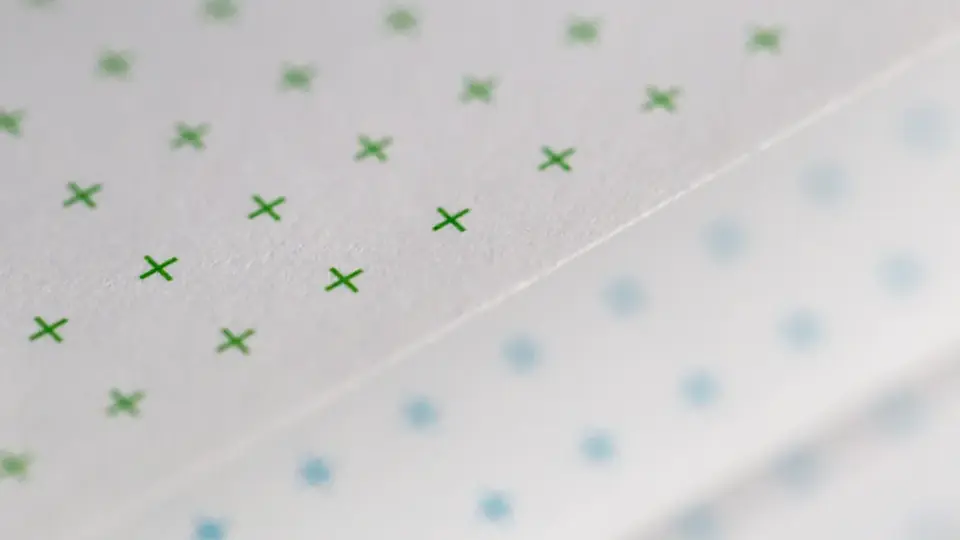
A close view of dot-grid paper, the dots printed in a pale green
Dot grid at 5 mm: the dots stay under the writing, not over it

The strapped cover and its refills

For people who fill books. A folded board cover in the same cloth with two elastic bands inside the spine, each holding one sewn 48-page refill. When a refill is done, slide it out, keep it, and slide a new one under the band. The cover outlives many refills.

Cover
2 mm binder's board, black cloth, two black elastic bands
Holds
Two 48-page refills at once
Refill paper
The same 90 gsm off-white, ruled or dot grid
Refill binding
One sewn section of 48 pages, soft card cover
Size
92 × 142 mm closed, a hair over the bound book
Weight
Cover 40 g · each refill 28 g
Bands
Replacement bands sold in pairs, cut to length

Refills fit the strapped cover only. The bound book's sections are sewn to its cover and cannot be swapped.

Paper

Why 90 gsm, and what the ruling is for

Grams per square meter is the weight of the sheet, and for a pocket book it is a trade between thickness and how much ink the paper can take. At 90 gsm the book stays under 70 g and closes to a size that fits a shirt pocket, while the sheet is heavy enough that a fountain pen does not feather and most inks stay on their side of the page. Heavier paper takes broad nibs better but makes a fatter book; lighter paper makes a thin book that ghosts.

The ruled version is lined at 6 mm, which suits ordinary handwriting without cramping it. The dot grid is 5 mm, printed in a pale green that sits under the writing rather than through it; it is the ruling for sketches, tables and lists that do not run in straight lines. Both rulings run to within 5 mm of the edge so the page is usable to the corner.

A close view of dot-grid paper, the dots printed in a pale green
Dot grid, 5 mm, printed pale enough to disappear under ink

Which pens bleed, and which do not

Tested on the bench, on the paper in the book, with the pen held the way a person writes. Bleed means ink came through to the other side of the sheet; show-through means you can see the writing faintly from behind but the paper is clean.

PenBleedShow-throughNote
Ballpoint, any widthNoneNoneSlight dent on the next page with a heavy hand.
Gel rollerball, fine or mediumNoneFaintDries in a few seconds; do not close the book at once.
Fountain pen, fine or medium nibNoneFaint to visibleNo feathering. Wet inks show more than dry ones.
Fountain pen, broad or stub nibOccasionalVisibleFine for one side of a page; write on both and it will annoy you.
Fineliner and technical pensNoneFaintThe paper's best match for the dot grid.
Felt-tip markers and highlightersYesHeavyBroad felt tips go straight through. Do not.

Binding

How it opens flat, and what that costs

A book opens flat when the pages are held at the fold and the spine is free to bend. Ours are sewn with linen thread through the center fold of each section, the three sections are sewn to one another, and the spine is lined with a strip of mull, a loose cotton gauze, before the block is glued into the cover. The cover's board stops short of the spine by a few millimeters, so it hinges rather than fights the block.

The cost is that a sewn spine is not a glued spine: the first and last pages are stitched, not just pasted, and you can see the thread at the center of each section. Some people mind. The other cost is that a sewn book cannot be refilled, which is why the strapped cover exists as a separate object rather than as a promise about the bound one.

  • Opens flat from page three; the first spread lies a little proud because the cover hinge is there.
  • Pages do not fall out. A section would have to tear along its whole fold first.
  • The ribbon is sewn into the spine, not glued, and can be trimmed if it frays.